
Personal leadership: more yourself, even under pressure
Personal leadership is the ability to choose how you respond in the moments that matter, instead of letting an automatic pattern choose for you. Under pressure, that choice isn't always easy. Discover why your brain falls back on familiar responses, what this means for your personal leadership, and how BrainRouting can help you develop new ways of responding.
What is personal leadership?
Personal leadership is not about your job title. It is about how you respond to what life brings your way, and how you actively shape the direction you want to take.
It means making conscious choices, taking responsibility for your actions and contributing to what matters to you. Not simply following your automatic patterns, but staying connected to your values and what you want to achieve.
Under pressure, this becomes more difficult. Your brain tends to fall back on familiar responses, even when you know you want to react differently. Personal leadership is about having more room to choose how you respond, instead of letting those familiar patterns take over.
Why it slips under pressure
Under pressure, your brain often falls back on familiar responses. You may become defensive, try to take control, adapt to others or become critical. These reactions begin before you consciously notice what is happening.
That is why you sometimes respond differently than you intended. Not because you don't know how you want to respond, but because a familiar pattern has already taken over. Others may barely notice, while you experience the tension or discomfort yourself.
Read more in Reacting under pressure.
Read also Calm on the outside, hit on the inside (in Dutch).
The patterns that get in the way
Under pressure, we all fall back on familiar patterns. Which ones do you recognise? Explore how they show up in everyday situations, why they are so persistent and what helps you respond differently.
Reacting under pressure
Staying calm on the outside while feeling tense inside. Or responding more sharply than you intended.
Read moreDifficult conversations
Criticism, pushback or feedback. Becoming defensive or withdrawing when a conversation becomes uncomfortable.
Read moreJudging and letting go
Having an opinion while remaining open to other perspectives. Or becoming defensive or disengaging when someone sees things differently.
Read moreSetting boundaries
Saying yes when you want to say no. Putting other people's needs ahead of your own to keep the peace.
Read moreHow we approach personal leadership
At Be More You, we explore personal leadership through two closely connected dimensions: how you manage yourself and how you relate to others. Together, they shape how you make choices, take responsibility and have an impact on the world around you.
How you manage yourself
Managing your energy and finding your balance again when life challenges you.
How you relate to others
Staying open to others while remaining connected to yourself.
Together, these four pillars give you a framework for exploring how you function, where familiar patterns affect your choices and what you want to develop.
Numbers: how many of 106 Be More You participants (50 SME business owners, 25 directors, 31 managers) name a theme from each pillar in their self-written development goals, 2026.
How do you respond differently under pressure?
When a familiar response takes over, consciously correcting yourself in the moment is often difficult. Your brain has already started down a well-practised route.
BrainRouting helps your brain practise alternative routes through direct feedback. As these routes become more accessible, you have more room to respond differently when it matters.
Your coach helps you recognise what happens in those moments, understand your experiences and connect what you learn during training to everyday situations.
That is why in BrainRouting you don't train what you should do, but what your brain can do.
Read more in Reacting under pressure.
What participants say
"At some point in the training I could really say to myself: I'm letting go of all control. And then the screen opened."
A participant describing a moment during BrainRouting training.
What makes BrainRouting different
Many personal leadership programmes focus on insight through reflection, conversations and practical exercises. Understanding your patterns is valuable. But knowing how you want to respond does not always mean you can do so when it matters.
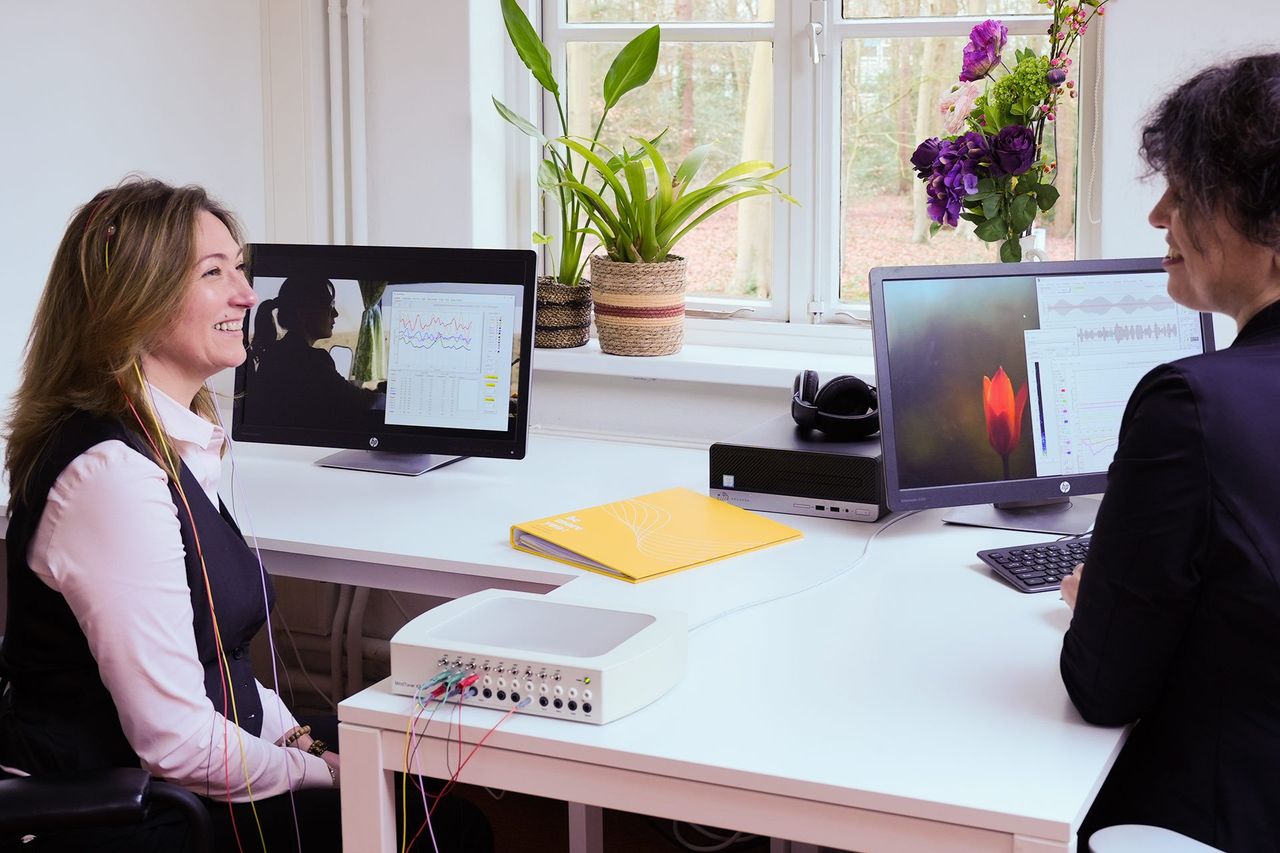
BrainRouting combines personal coaching with brain training. While your brain receives direct feedback based on measured brain activity, you work with your coach to recognise familiar patterns, explore different responses and connect what you experience to everyday situations.
This way, you develop more than insight. You also train your brain to make different responses more accessible.
You can start with MindMirror, a 1.5-hour introduction to BrainRouting, or begin with Balance, our two-day foundation programme with six months of follow-up guidance.
Explore our programmes, including prices and how to use your training budget.
How another route becomes available
Your old reaction doesn't disappear. Your brain learns that there is another one, and chooses it more and more often by itself.
Your brain takes the familiar route
Under pressure, your brain often falls back on familiar responses, even when you know you want to react differently.
Your brain activity is measured
The sensors continuously measure your brain activity, including changes you may not yet be consciously aware of.
Your brain gets direct feedback
The screen opens or closes based on measured brain activity. Your brain learns from this immediate feedback.
Other routes become more accessible
Through repeated practice and feedback, your brain strengthens alternative routes, making them easier to access in daily life.
“I was always stuck in my head. Last night, for the first time in my life, my mind went quiet. It is as if I found a 'reset button'.”

Frequently asked questions about personal leadership
Personal leadership is not about your job title. It is about making conscious choices, taking responsibility for your actions and actively shaping your own direction. It also means having more choice in how you respond, rather than automatically falling back on familiar patterns.
Under pressure, your brain often falls back on familiar responses, even when you know you want to react differently. These automatic reactions begin before you consciously notice what is happening.
Read more in Reacting under pressure.
Under pressure, your brain tends to fall back on familiar responses. BrainRouting helps your brain practise alternative routes through direct feedback, making different responses more accessible when it matters.
This gives you more room to choose how you respond, rather than trying to control your reactions in the moment.
When you face new challenges or take on responsibility, you may start doubting yourself, even when you have the knowledge and experience you need.
Sometimes this doubt reflects something you still need to learn. Sometimes it is a familiar pattern that makes you question yourself unnecessarily.
BrainRouting helps you recognise that difference and train your brain to respond with more confidence, rather than automatically falling back on self-doubt.
Read also Ben ik hier wel goed genoeg voor? (in Dutch).
Traditional personal leadership training often focuses on insight, reflection and behavioural exercises. BrainRouting adds objective measurements of brain activity and direct feedback, allowing your brain to practise alternative responses.
Brain training and personal coaching form one integrated approach. Your coach helps you understand your experiences, recognise familiar patterns and apply what you learn in everyday life.
So you don't just gain insight into how you respond. You also train your brain to make different responses more accessible.
Many participants use their employer's training budget to pay for a BrainRouting programme. On our Programmes page you'll find the prices and what's included in each programme.
Which pattern takes over for you under pressure?
The Automatic pattern scan shows you in a few minutes what your brain does automatically under pressure. You receive a personal report.